37 billion tons of raw material. Why we still don't make fuel from CO2
A nanoparticle that cannot be seen
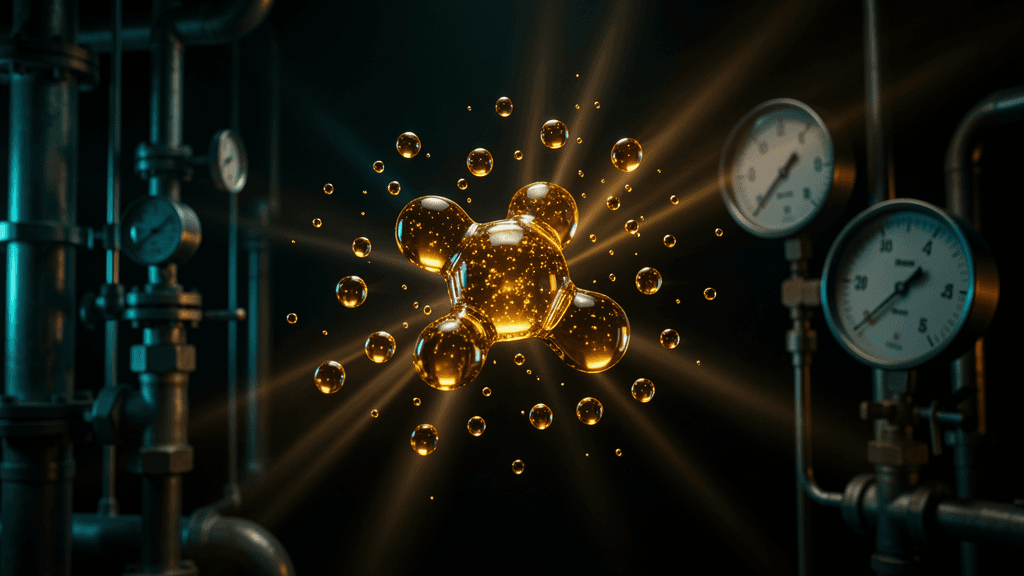
In a laboratory at the University of Bologna, Nikolaos Dimitratos looks at the screen of an electron microscope. What he sees is three nanometers in diameter - about the same size as a human fingernail grows in three seconds. This tiny bit of copper-zinc alloy performs a dance that chemists have been trying to learn for forty years: it grabs a carbon dioxide molecule, breaks one of the two double bonds between carbon and oxygen, and sticks hydrogen atoms in its place. The final product is methanol. A liquid that can be poured into the tank of a modern car without modification.
Three nanometers. And the effect of the same reaction - if scaled to billions of nanoparticles in a tanker-sized reactor - is 1,000 tons of methanol per day from air and water. The contrast, which is difficult to comprehend, is the essence of the story told by the review published in 2025 inScience: Catalytic hydrogenation of CO₂ – the chemical pathway from waste to fuel – has been operating in the laboratory for decades. Works beautifully. It just doesn't work on a scale that would matter.
37 billion tons and one reaction
Humanity emits 37 billion tons of carbon dioxide per year. Two-thirds of this – about 25 billion tonnes – comes from burning fossil fuels. The same ones that we could theoretically replace with fuel made from CO₂. Perfect circle: we burn fuel → we emit CO₂ → we capture it → we hydrogenate it back into fuel → we burn it. Zero net new carbon in the atmosphere.
Problem? This circle is square.
Review by Jingyun Ye (Duquesne University), Nikolaos Dimitratos (Bologna), Liane Rossi (Universidade de São Paulo), Nils Thonemann (Leiden), Andrew Beale (Rutherford Appleton Laboratory) and Robert Wojcieszak (CNRS, France) - published inSciencein 2025 - shows why. It's not that we can't react. The reaction CO₂ + 3H₂ → CH₃OH + H₂O has been exothermic, thermodynamically favorable, and has operated in the presence of a copper-zinc catalyst since Imperial Chemical Industries patented the process in 1966. The Icelandic George Olah Plant has been converting CO₂ from a geothermal power plant into methanol continuously since 2012. The Chinese company Shenghong Petrochemical opened an installation in 2024 capable of producing 150,000 tons of methanol per year from captured CO₂.
The problem is cost. To produce one tonne of methanol from CO₂, you need 190 kilograms of green hydrogen. Hydrogen from electrolysis today costs $5-7 per kilogram - which works out to $950-1,330 for a ton of methanol alone. Meanwhile, methanol from natural gas — gray, dirty, but cheap — costs $300 to $400 a ton. The difference is threefold and sometimes fourfold.
AuthorsScienceindicate that the key lies in the catalyst—specifically in understanding how the structure of the active site (metal, oxide, carbide) determines the selectivity of the reaction. Rearranging one copper atom on the surface of a nanoparticle by a tenth of a nanometer can change the product from methanol (a fuel) to methane (a greenhouse gas) or carbon monoxide (an industrial intermediate). Control at the level of a single atom determines the economics of an entire industry worth hundreds of billions of dollars.
"Existing catalytic converters require improvement," they write bluntly. "The identification of active sites and the understanding of interactions between components and the dynamic behavior of the participating particles remain unclear." To put it simply: we look at the engine, we see that it is turning, but we do not know exactly which piston is doing what.
Fuel that already exists - only on a drop scale
Despite this, the e-fuel market has already emerged. And it is growing faster than the costs themselves would suggest.
Global production of e-methanol in 2025 amounted to approximately 250 thousand tons. For comparison: the world consumes 100 million tons of methanol per year - mainly as a raw material in the chemical industry. The share of e-fuels in the global market today is 0.25 percent. A drop in the ocean of crude oil.
But the dynamics are impressive. The International Renewable Energy Agency (IRENA) forecasts an increase to 5 million tonnes of e-fuels per year by 2030. By 2050 — 200 million tons per year. The gap to be filled between "today" and "2040" is larger than Saudi Arabia's entire current oil production.
Aviation is the engine of growth. A passenger plane cannot fly on batteries - the energy density of a lithium-ion battery is 0.3 kWh per kilogram, jet fuel is 12 kWh per kilogram. A forty-fold difference. Boeing and Airbus are testing 100 percent synthetic aviation fuel (e-SAF) from 2023. The European Union has introduced a mandate: from 2030, every refueling at European airports must contain a minimum of 1.2% synthetic fuel. From 2035 - 5%. From 2050 - 35%. For an industry that currently consumes 360 billion liters of kerosene per year, this means a guaranteed demand for 126 billion liters of e-fuel per year.
Companies are already setting up. HIF Global — a Chilean-German consortium — has raised $260 million to build the Haru Oni plant in Patagonia, producing 750,000 liters of e-gasoline a day. The key is location: the wind in Patagonia blows at an average speed of 12 meters per second 300 days a year, giving electricity prices of less than 3 cents per kWh - one third of the European price. Infinium in Texas opened a Project Roadrunner facility in 2024, producing e-fuels from captured CO₂ and green hydrogen for Amazon - Amazon's electric delivery trucks will refuel with CO₂ fuel.
Płock at the coal crossroads
Poland enters this history from a position it did not choose, but which it can turn into an advantage.
Grupa Azoty - the second largest producer of nitrogen fertilizers in the European Union - consumes 2.5 billion cubic meters of natural gas annually as a raw material for the production of ammonia and methanol. It imports most of this gas, mainly from Russia and Norway. CO₂-to-methanol technology could close the carbon loop in Puławy: CO₂ from production processes (which today goes up the chimney) + green hydrogen from electrolysis = methanol and ammonia without natural gas. Green ammonia, in turn, is a raw material not only for fertilizers, but also for marine fuels - Maersk has already ordered 25 methanol-powered container ships.
Orlen in Płock - the largest refinery and petrochemical complex in Central Europe - emits approximately 12 million tons of CO₂ annually. That's more than all of Slovakia. It currently pays around €80 for each tonne under the EU Emissions Trading Scheme (EU ETS) - almost a billion euros a year. European Commission forecasts indicate that by 2030 the price of allowances may reach EUR 150 per tonne. At this price, Orlen would pay EUR 1.8 billion annually for the emission rights alone.
The alternative: capture CO₂ from the stack, add hydrogen from electrolysis powered by an offshore wind farm, and sell the product as e-fuel with a premium for sustainability. This isn't science fiction. Shell is building such a value chain in Rotterdam from 2023 - the Holland Hydrogen I plant with a capacity of 200 MW of electrolysers, powered by the Hollandse Kust offshore wind farm.
Polish universities are not idle either. Krzysztof Wacławiak from the AGH University of Science and Technology is researching metal hydrides as materials for storing hydrogen - without efficient H₂ storage, the entire CO₂-to-fuel chain makes no economic sense. Adam Cenian from the Institute of Fluid-Flow Machinery of the Polish Academy of Sciences in Gdańsk is working on plasma reactors for converting biomass and CO₂ into liquid fuels. This is TRL 3-4 research - laboratory proof of concept - while competition in Chile, Texas and China is now moving to TRL 7-8, i.e. industrial-scale demonstration.
Difference? Chile is building a factory. Texas is building a factory. Poland is debating a hydrogen strategy, the sixth version of which from 2021 has still not been adopted by the Council of Ministers.
Catalyst in 18 months
However, there is reason for cautious optimism - and it has an atomic dimension, exactly as the authors write aboutScience
Advances in catalyst design – driven by machine learning and quantum computing – are reducing the time it takes to find a new catalytic material from 5-7 years to 12-18 months. In 2024, a team from the University of Toronto used a deep learning algorithm to search a space of 20,000 potential catalytic alloys for CO₂ reduction — and found a candidate that outperformed pure copper by 40% in ethanol selectivity, within six months. Google DeepMind and Microsoft Research are investing hundreds of millions of dollars in generative models for materials design - Nature published Microsoft's groundbreaking work on the generative design of inorganic crystals in 2025.
If the pace of progress continues, the first fully AI-designed catalyst capable of producing methanol from CO₂ at a price competitive with natural gas could appear before 2030. Then the economics of the entire sector will shift from "subsidize or die" to "pays for itself."
For Poland, this is an 18-month decision-making window. The time needed to announce the first auction for contracts for difference for green hydrogen (analogous to the system that launched offshore wind farms in the Baltic Sea). It's time to decide whether Płock will be an importer of technology from Chile and Texas, or an exporter of know-how with its own demonstration plant.
Sources
Ye J., Dimitratos N., Rossi L.M., Thonemann N., Beale A.M., Wojcieszak R.Hydrogenation of CO₂ for sustainable fuel and chemical production. Science, 2025. DOI:10.1126/science.adn9388
Odenweller A. et al.The green hydrogen ambition and implementation gap. Nature Energy, 2025. DOI:10.1038/s41560-024-01684-7
Zeni C. et al.A generative model for inorganic materials design. Nature, 2025. DOI:10.1038/s41586-025-08628-5
International Energy Agency (IEA).CO₂ Emissions in 2024. Paris, 2025.
IRENE.Innovation Outlook: Renewable Methanol. Abu Dhabi, 2025.
European Commission.ReFuelEU Aviation Regulation. Brussels, 2025.
Mekonnin A.S., Wacławiak K.Hydrogen Storage Technology, and Its Challenges: A Review. Catalysts, 2025. DOI:10.3390/catal15030260
Comments· 0
No comments yet. Be the first.