23 kilograms that change everything
23 kilograms that change everything
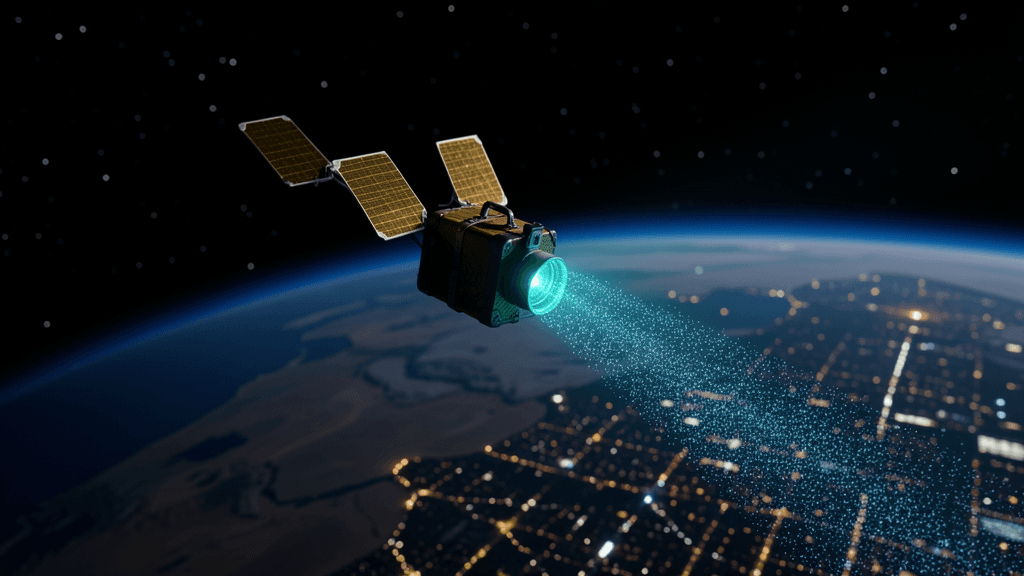
July 27, 2022. A rocket takes off from a spaceport in China. On board - the Jinan-1 satellite, barely larger than an average suitcase. Its quantum charge weighs 23 kilograms. Less than Ryanair's checked baggage.
Four years earlier, the same team of Jian-Wei Pan - the physicist who built China's quantum program from scratch - sent Micius into orbit. The first quantum satellite in history weighed 600 kilograms. His optical ground station? Thirteen tons of concrete, steel and precision optics. To retrieve a single encryption key from space, a small astronomical observatory had to be built. On the roof of a building? There was no way.
Jinan-1 changes everything. The load is an order of magnitude lighter - 23 kg instead of hundreds. Ground station - 100 kilograms, which is two hundred times lighter than its predecessor. It can be placed on the roof of an office building in downtown Jinan. And that's where it was placed. Next door - on the outskirts of Hefei, in the Nanshan Mountains near Urumqi, in the center of Wuhan. Four stations, four cities, one satellite in orbit 500 kilometers above the Earth.
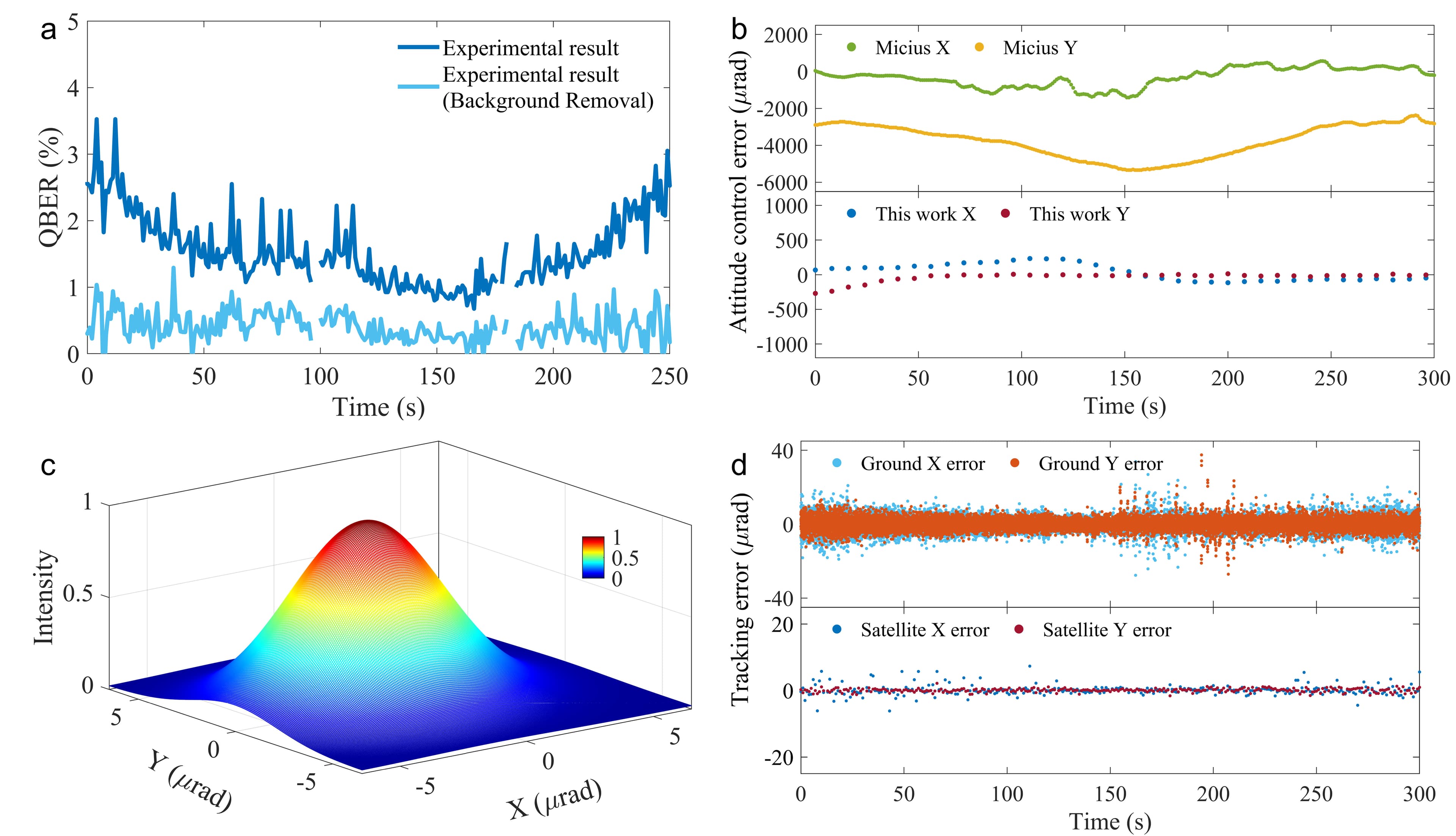
During a single flight — lasting about six minutes — Jinan-1 transferred 571,000 bits of a quantum secure key. Transmission error? 0.99%. In practice: for every million bits there is less than one false bit. This is not a laboratory experiment. This is an operational infrastructure operating in a series of routine flights from September 2022 to July 2023.
A photon that cannot be overheard
To understand why 23 kilograms in orbit is a breakthrough, you have to go back to the basics. Quantum key distribution (QKD) exploits a fundamental principle of physics: you cannot measure a quantum state without perturbing it. This is not a technological limitation that can be overcome with better equipment - it is a mathematical consequence of Heisenberg's uncertainty principle.
In practice: the satellite sends single photons - literally particles of light - in one of four polarizations. Each photon carries one bit of the cryptographic key. If anyone tries to capture and read this photon, its quantum state will be irreversibly changed. The recipient will immediately detect that the key has been compromised - and will discard it. This mechanism is resistant to any computational power. Even the quantum computer of the future, capable of cracking RSA-2048 in seconds, is powerless against the BB84 protocol.
The problem has always been transmission. Fiber optic attenuates photons - after 200 kilometers the signal is too weak. A quantum amplifier does not exist (and will probably never exist - forbidden by the non-cloning theorem). Satellites get around this problem: the vacuum of space has virtually no attenuation of photons, and a single pass over two ground stations can connect distant continents in a matter of minutes.
Jinan-1's key innovation does not lie in its photon source. It is an 850 nm laser diode generating pulses at a frequency of 625 MHz - a technology that has been known for a decade. The real breakthrough is the miniaturization of the guidance system and the addition of two-way optical communication.
In Micius, a complex opto-mechanical system was responsible for tracking the ground station: an external movable mirror and an internal precision mechanism. Heavy, delicate, expensive. Jinan-1 uses flywheels to directly control the orientation of the entire satellite, with no moving optical parts. Precision? 0.55–1.6 microradians. That's the equivalent of hitting a buck with a laser pointer from 500 kilometers away — and maintaining the beam while both objects are moving at 7.8 km/s.
The second innovation: multiplexing. Jinan-1 combines quantum communication (850 nm photons) with classical optical communication (1538 nm laser) in one channel. Why is it important? Because after sending the key, it still needs to be agreed between the sender and the recipient - a process called "key distillation" - which was traditionally done over a slow microwave link, with delays counted in hours or days. Jinan-1 does this optically, in real time. During its September 25, 2022 flyby, the satellite not only transmitted photons — it negotiated, verified, and delivered a ready key in the same six minutes.
Paper satellite
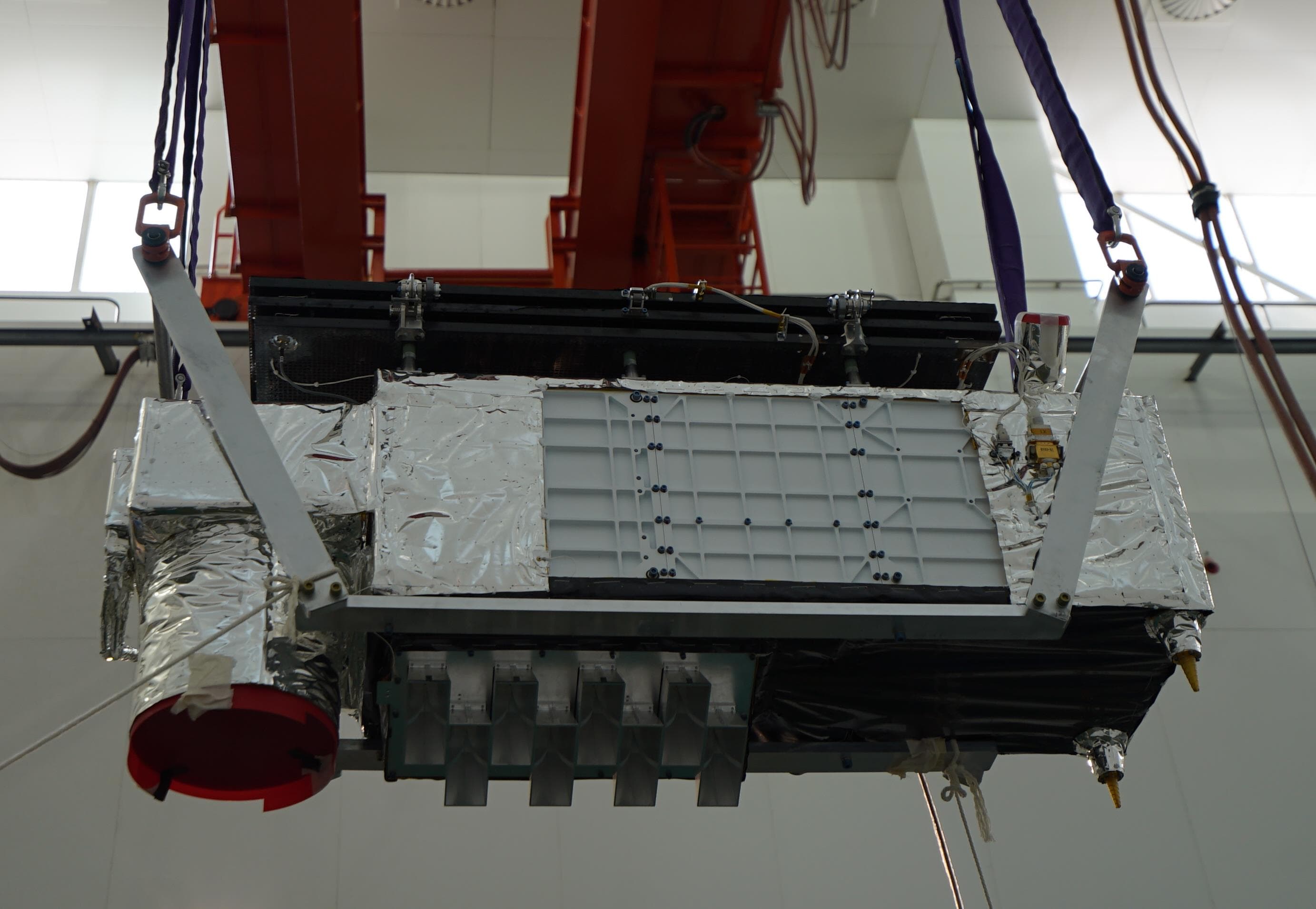
Jinan-1 dimensions in launch configuration: 1.37 × 0.49 × 0.65 meters. About the same as a standard office wardrobe. On-board telescope: aperture 200 millimeters - smaller than in an amateur astronomical telescope for PLN 2,000. Ground station: 280 millimeters. No observation domes, no foundation concrete slabs. One operator sets it up in 30 minutes and connects it to a regular socket.
Pan's team tested Jinan-1 every day for almost a year. Four stations - three urban (large-city light pollution, suspended dust, atmospheric turbulence) and one mountain (Nanshan, Kashgaria, 2000 m above sea level). Results? QBER below 1% every time. Not a single failed session during the entire testing period. The system works even when the satellite passes through the terminator - the day-night boundary, where temperature changes cause the greatest mechanical stress.
In April 2025, the team published their results in Nature. 120 citations in 12 months - in astronomy this is average, in quantum engineering it is the hit of the decade. Jinan-1 is no longer the only QKD microsatellite in orbit — QuantumCTek, USTC's commercial partner, has already built a successor. But it was this work that proved that the technology had scaled from the domain of experimental physics to aerospace engineering.
A race that has three players and one goal
The QKD market is growing at a rate of 27% annually. By 2030, it is expected to be worth $5.6 billion. But it's not commercial terminal sales that are driving this growth - it's geopolitics.
China does not hide its plans. Jinan-1 is the first element of a constellation of several dozen microsatellites that is expected to give Beijing a global secure communications network by the end of the decade. The Beijing-Shanghai terrestrial link - 2,000 km, 32 nodes, 4 metropolises - has been operating continuously since 2017. Additionally, integration with the mobile network: in 2024, the Chinese Ministry of Science launched a program to connect QKD with 5G/6G infrastructure. If the satellite constellation closes the transoceanic gap, China will be the first country with a global network resistant to hacking by any computer - including a quantum one.
Europe responds to EuroQCI - European Quantum Communication Infrastructure. Budget: €1.6 billion, co-financed by the European Commission and ESA. Goal: European terrestrial network integrated with satellites by 2027. Luxembourg's SES - the largest satellite operator in Europe - is already testing quantum links between GEO satellites and ground stations. Thales Alenia Space is building Eagle-1, the first European QKD satellite, scheduled for launch in 2026. In parallel, Germany, Austria, the Czech Republic and Italy are launching their own ground test sections.
The United States chose a different strategy: instead of a dedicated constellation, miniaturization of QKD terminals to a size enabling installation on commercial satellites. DARPA is funding the Quiness program to accommodate the QKD terminal in the CubeSat standard. In theory, 40,000 Starlink satellites with quantum terminals provide instant global coverage. In practice - no one has yet demonstrated QKD between two satellites moving at orbital speeds. A network connecting Washington, Chicago and laboratories in Colorado is already operational on Earth, but the orbital segment is still at the demonstrator stage.
Three players, three strategies, one stake: the first to build an operational constellation will control the security foundations of global communications for the next decade.
Poland is building satellites. It doesn't build quanta.
Creotech Instruments - a Polish company listed on the Warsaw Stock Exchange, market valuation of approximately PLN 300 million - has built the HyperSat platform and supplies components for ESA. SatRevolution from Wrocław has already placed several observation nanosatellites in orbit. KP Labs from Gliwice, specializing in onboard AI for satellites, has just entered into a contract with ESA for the next Deep Thought mission. Poland has the competence to build small satellites. He has companies. It has proven engineers.
What's missing? Quantum charge. Not one.
Poland has formally participated in EuroQCI since 2023. On paper, we are in the program. In practice: not a single ground-based QKD node has been built yet, let alone a satellite with a quantum payload. Meanwhile, the Czechs have already launched a Prague-Brno quantum link (120 km) on the CESNET infrastructure. Austrians - QKD integration with A1 Telekom networks. Germany has several nodes and its own QUBE satellite program, scheduled to launch in 2025.
The reasons are not physical. Polish researchers have been publishing in the best journals for years: the group of prof. Demkowicz-Dobrzański from the University of Warsaw (quantum metrology and security), the team of professors Horodecki from the Nicolaus Copernicus University in Toruń (quantum information theory, entanglement), the Krakow group of prof. Żukowski from the Jagiellonian University, Center for Theoretical Physics of the Polish Academy of Sciences. Polish quantum physics is at the forefront in Europe.
The problem lies in the scale of financing. QuantumCTek — a commercial spin-off of USTC that co-created the Jinan-1 payload — raised $220 million in a B round. It employs 600 people. Polish National Quantum Fund? It doesn't exist. NCN grants in this field amount to PLN 1-2 million for a three-year project - as much as one box of satellite on-board electronics.
However, there are three real paths to avoid being left behind.
Firstly: ESA announced the SAGA (Security And quantum information for Generic Applications) program in 2025 with a budget of EUR 80 million for the miniaturization of QKD terminals to the CubeSat format. Poland, as a full member of ESA, can submit applications. In the first call for proposals - zero Polish consortiums. The second recruitment opens in 2026. Time to form a consortium: Creotech (satellite platform) + one of the quantum groups (payload) + telecommunications operator (Orange Polska or Exatel as an implementation partner).
Secondly: integration instead of construction. Instead of creating a QKD payload from scratch, you can buy ready-made components from European suppliers - Swiss ID Quantique (world leader in commercial QKD), Austrian AIT (specializing in miniaturization), German Tesat-Spacecom (laser terminal for satellite communications) - and integrate them with the HyperSat platform. Creotech is already integrating payloads for ESA: EagleEye, the first Polish observation satellite, flew on HyperSat in 2024. Same carrier - different payload.
Third and most urgent: EuroQCI ground nodes. Each member state is to build a minimum of two nodes by 2027. Poland hasn't started yet. Cost of a single node: €2-3 million - as much as an average ERC grant. For comparison: NCBR has an annual budget of PLN 1.5 billion. Two QKD nodes are less than half a percent of that amount.
The stakes for Poland - a country on NATO's eastern flank, neighboring the Königsberg Oblast and Belarus - are higher than for the Czech Republic or Austria. The first Central and Eastern European country to build an operational EuroQCI node and integrate it with the satellite segment becomes a regional quantum security hub. For banks. For the army. For critical infrastructure.
Jinan-1 has proven one thing: 23 kilograms is enough to build a link in the global quantum network. Poland can already put 23 kilograms into orbit. He doesn't know what to put in them yet.
Sources
- Li Y. et al.,Microsatellite-based real-time quantum key distribution, Nature (2025), DOI:10.1038/s41586-025-08739-z
- Liao S.K. et al.,Satellite-to-ground quantum key distribution, Nature 549, 43–47 (2017), DOI:10.1038/nature23655
- Chen Y.A. et al.,An integrated space-to-ground quantum communication network over 4,600 kilometers, Nature 589, 214–219 (2021), DOI:10.1038/s41586-020-03093-8
- European Commission,European Quantum Communication Infrastructure (EuroQCI), Digital Strategy (2023)
- ESA,SAGA - Security And quantum information for Generic Applications, ARTES 4.0 (2025)
- MarketsandMarkets,Quantum Key Distribution Market - Global Forecast to 2030(2025)
[[FIGURE:1]] [[FIGURE:2]]
Comments· 0
No comments yet. Be the first.