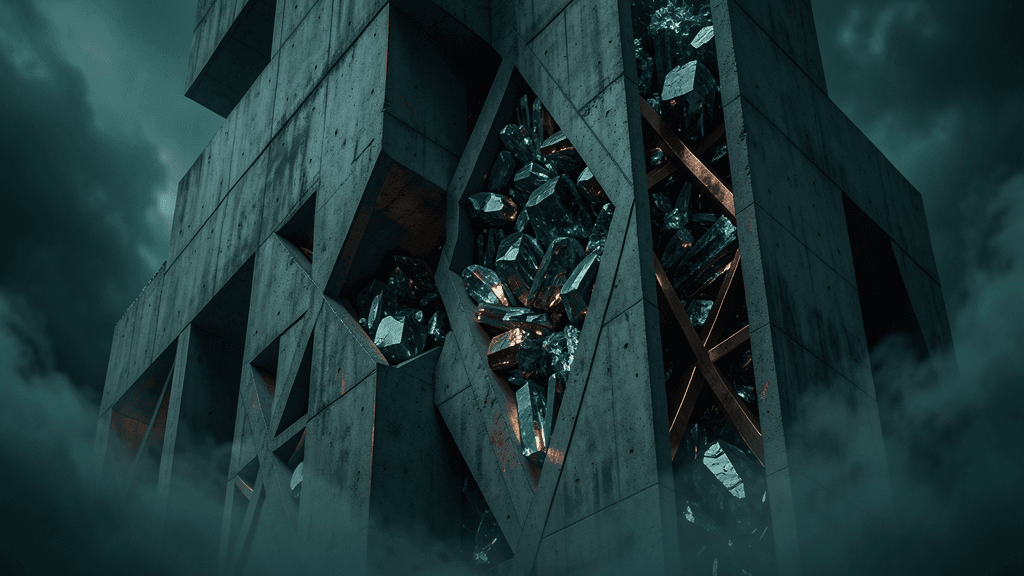
16 billion tons under roof. Why buildings can be the largest CO2 store on Earth
When Elisabeth Van Roijen was starting her PhD at the University of California at Davis, her supervisor, Professor Sabbie Miller, asked her a question that sounded like a trick exam riddle: how much CO2 could all the world's buildings store if they were built from materials that can already absorb carbon dioxide?
Van Roijen spent two years on this question. The answer she found — 16.6 billion tons of CO2 per year — was so surprising that reviewersSciencethey had the team repeat the calculations three times. The number was right. The problem was that for decades no one bothered to count it.
Three walls against which carbon-negative construction crashed
For the past thirty years, the conversation about emissions in construction has focused solely on reduction. Cement accounts for 8% of global CO2 emissions – more than all air transport, more than India as a country. The industry promised "green concrete", "low-emission cement", "carbon neutrality by 2050". Everyone was thinking about how to emit less. No one thought about the fact that building materials can actively withdraw CO2 from the atmosphere.
Wall #1: Nobody cared about "negative".For decades, climate policy towards construction has had one goal - reduction. The Kyoto Protocol, then the Paris Agreement, then the EU ETS - everything measured emissions, penalized emissions, traded emissions. No one has created a mechanism that would reward for storing CO2 in the building wall. Without this mechanism, there was no economic incentive for anyone to ask the question Miller asked.
Wall #2: Data on global production of building materials was scattered and incomparable.When the Davis team tried to crunch the numbers — concrete tonnage in China, brick production in India, structural lumber consumption in Europe — they hit a brick wall. Chinese production data was incomplete. The Indian brick sector operated largely informally. Even US asphalt data varied by 30% between sources. For the first six months of the project, the team was unable to build even a skeleton model.
Wall #3: Climate economists treated carbon sequestration as the domain of geology, not construction.For years, the dominant paradigm was that CO2 had to be pumped deep underground — into depleted oil deposits, salt formations, and deep aquifers. CCS (Carbon Capture and Storage) costs $50-150 per tonne and requires infrastructure that does not exist. But no one asked whether it would be cheaper and simpler to simply change the concrete recipe.
"It was like looking for keys under a lamppost," Miller said in an interview after publication. "Geological sequestration is where the light is - we have models, we have financing, we have regulations. And construction? Construction has been in the dark, even though we use 30 billion tons of concrete a year."
Breakthrough: mathematics instead of laboratory
The team's key decision was methodological, not technological. Van Roijen, Miller and Davis did not perform any new laboratory experiment. They didn't synthesize new material. Instead, they built a model — a global matrix connecting seven categories of building materials with their carbon storage potential and production data from dozens of countries.
The model included: aggregate in concrete, cement binders, bricks and blocks, construction wood, insulation, asphalt and finishing materials. For each category, the team identified an existing carbon storage equivalent - not in the conceptual phase, but already in production and tested in practice.
Specifically: carbonated aggregate concrete - where crushed concrete waste is exposed to CO2, which reacts with calcium hydroxide to form a stable carbonate. Construction wood from certified crops - each tree contains CO2 stored through photosynthesis, locked in the building's frame for decades. Biochar added to cement - a biomass pyrolysis product that not only stores carbon in the concrete matrix, but also improves thermal insulation, reducing building operational emissions. Magnesite cement binders - which, instead of emitting CO2 (like Portland cement), need it to set.
The key finding was counterintuitive: total storage potential depends much more onscale of material usethan on the amount of carbon stored per unit mass. In other words, you don't need a miracle nanomaterial. Just take materials that already exist, storing 50-200 kg of CO2 per tonne, and apply them on the scale of global construction.
"It's a bit like solar panels," explained Davis, whose previous work on global carbon flows has been cited in IPCC reports. "A single panel doesn't make much of an impression. But when you cover every roof with them, suddenly you have a power plant the size of a country."
The figure of 16.6 billion tonnes ±2.8 billion tonnes takes into account uncertainty in production data - mainly for China and India, where construction statistics are the least reliable. Even the lower limit – 13.8 billion tonnes – represents about 40% of 2021 global anthropogenic emissions.
Concrete aggregate has the greatest potential - storing CO2 in aggregate alone could generate 8.8 billion tons per year. Second place is taken by structural wood - 3.7 billion tons. The rest is distributed between bricks, insulation and binders.
They're already doing it - but no one calls it CO2 storage
The greatest irony of Van Roijen's work is that CO2 storage materials are not theoretical. They are already on the market - but no one thinks about them in terms of carbon sequestration.
Norway has Mjøstårnet - an 85-meter skyscraper made of cross-laminated timber, which has stored approximately 2,000 tons of CO2 in its structure. Swiss start-up Neustark has already installed 40 CO2 digestion devices in recycled concrete - each the size of a container, each processing 10 tons of CO2 per day. In the U.S., CarbonCure injects CO2 into fresh concrete at more than 700 plants - the technology involves CO2 reacting with calcium ions in the concrete mix to form calcium carbonate nanocrystals, which both strengthen the concrete and permanently bind carbon dioxide.
The problem is not that the technology does not exist. The problem is that the construction industry - from architects to developers - never got the simple message: "your buildings can be not only less harmful, but actively helpful."
The CRCF certificate, which the European Union plans to launch by 2027, is intended to change this. The CRCF will create a single standard for certification of CO2 removal – similar to how energy certificates have transformed the real estate market in the last decade. A building with a negative carbon footprint will have a measurable market value. A developer who uses CO2 storage materials will be able to sell the certificates on the voluntary market or - if the CRCF is integrated into the EU ETS - on the regulated market.
Poland: a cement power at a crossroads
Poland is the third largest cement producer in the European Union - after Germany and Italy. We produce approximately 19 million tons annually. The Górażdże (Heidelberg Materials), Lafarge (Kujawy, Małogoszcz), Cemex (Chełm, Rudniki) and Dyckerhoff (Nowiny) plants employ a total of over 4,000 people and generate revenues of PLN 6 billion annually.
The problem is that each tonne of Portland cement emits approximately 600 kg of CO2. At 19 million tons per year, we are talking about 11.4 million tons of CO2 - more than the entire domestic aviation, including LOT and transit traffic, emits. The EU ETS 2 system, which will also cover construction from 2027, will make each tonne of CO2 cost more and more - currently around 80 euros, with forecasts reaching 150 euros by 2030. For Polish cement plants, this means a potential additional cost of EUR 1.7 billion per year.
Some Polish institutions are already reacting. At the Silesian University of Technology, the team of prof. Izabella Maj investigates the use of biomass ashes as an additive to concrete - a material that simultaneously reduces emissions and stores carbon. AGH University of Science and Technology in Krakow analyzes the use of photovoltaic waste as aggregate in building structures. Work is underway at the Gdańsk University of Technology on geopolymer concretes - where the binder is not Portland cement, but alkaline-activated fly ash and blast furnace slag, by-products of Polish coal-fired energy.
But this is still laboratory scale, not industrial scale. Poland does not have a single plant producing concrete with carbonated aggregate on a commercial scale. No Polish cement plant has implemented the CO2 injection technology into concrete, which the Canadian CarbonCure already uses in hundreds of plants in North America. No Polish developer offers a building whose carbon footprint would be negative thanks to construction materials.
Meanwhile, the competition is not sleeping. The Swiss start-up Neustark installs CO2 mineralization devices in concrete in several European countries - each device the size of a shipping container mineralizes 10 tons of CO2 per day in recycled aggregate. British Seratech produces magnesia cement, which needs CO2 to bind rather than emit it. The French Hoffman Green Cement Technologies has launched a low-carbon cement factory with a capacity of 250,000 tons per year.
The stakes for Poland are twofold: environmental and economic. If the European construction market switches to carbon storage materials - and the EU Carbon Removal Certification Framework (CRCF) is scheduled to come into force by 2027 - Polish cement plants without this technology will lose competitiveness. 19 million tons per year will either have to be sold at a discount to non-EU markets or pay increasing penalties for emissions whose cost exceeds the margin.
Paradoxically, transformation is also an opportunity. Poland has access to raw materials - fly ash from coal-fired power plants, blast-furnace slag from the steel industry, agricultural biomass - that could become the basis for a new generation of carbon storage materials. We have four large cement plants with modern production lines that could be adapted to new technologies. We have engineering staff, five technical universities with materials engineering departments and one of the largest construction markets in Central and Eastern Europe - 220,000 new apartments a year, hundreds of kilometers of roads, thousands of warehouse halls.
But time is running out. CRCF enters in 2027. EU ETS 2 will cover construction no later than 2028. Cement plants that today export to Germany and the Czech Republic will tomorrow compete with local plants that are already investing in CO2 storage technologies. Heidelberg Materials - the owner of Górażdże - has just announced the construction of the world's first cement plant with full CO2 capture in Brevik, Norway. Lafarge is testing biochar cements in France. Cemex has launched a carbonated concrete pilot in Mexico.
The question is no longer "can the Polish cement industry survive without CO2 storage technology?" The question is: "who will be the first to implement them on the Vistula and get CRCF certificates before the competition from Germany does?"
Professor Miller and her team have given the industry something that has been missing for decades: not new technology, but proof that those that already exist, used together and on a global scale, can flip the construction equation from "harm less" to "actively repair." 16.6 billion tons per year is not science fiction. It's math - and several million tons of cement waiting for a new recipe.
Sources
- DOI: 10.1126/science.adq8594— Van Roijen E., Miller S.A., Davis S.J.,Building materials could store more than 16 billion tonnes of CO₂ annually,Science, vol. 387, pp. 176–182 (2025).
- Cement Industry in Poland - production data:Polish Association of Cement Producers, annual report 2025.
- EU ETS 2: extension of the emissions trading system to construction and transport— European Commission (2026).
- Carbon Removal Certification Framework (CRCF)— European Commission, regulations coming into force in 2027.
- Neustark - CO₂ mineralization in demolition concrete— Swiss start-up, CO2 mineralization technology in concrete aggregate.
- CarbonCure Technologies— Canadian company, CO2 injection technology into fresh concrete, implemented in 700+ plants.
Comments· 0
No comments yet. Be the first.