A lung in reverse
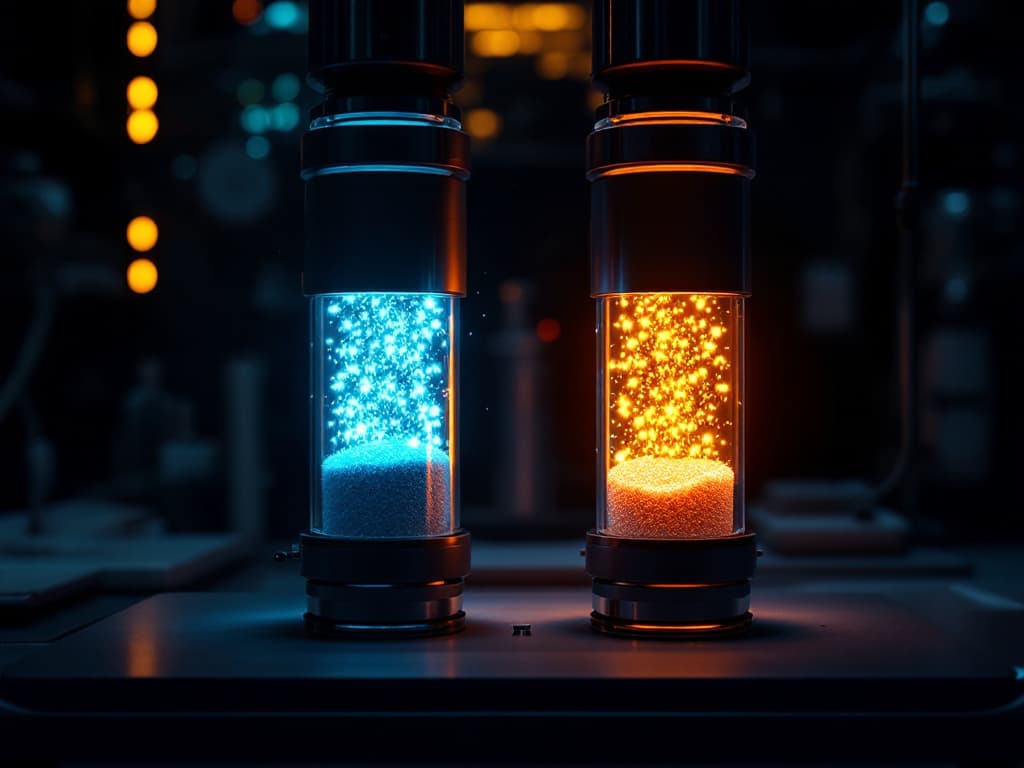
It is night in a laboratory in Cambridge. Air flows through a glass tube six millimetres in diameter — the same air we breathe on the street. Four hundred CO₂ molecules per million. That is all the machine has to work with.
Here lies the heart of a problem that looked unsolvable for decades. Carbon dioxide is at once the biggest waste of our civilisation and one of the hardest ingredients of air to catch. We pump forty billion tonnes a year into the atmosphere, yet in every litre of air you inhale, CO₂ is a mere four ten-thousandths. A fraction.
To capture a single tonne of CO₂, you have to push a filter through the volume of twenty-five Olympic swimming pools.
And we must capture not a tonne, not a million tonnes, but billions. The IPCC reports are unambiguous: halting emissions is not enough. Even if we stopped burning fossil fuels tomorrow, the atmosphere would hold all the CO₂ accumulated over a hundred and fifty years. To keep warming within liveable limits, we will have to actively remove five to ten billion tonnes a year from the air by the end of the century. It is like sifting salt out of the ocean — with a teaspoon, but on a planetary scale.
A team led by Erwin Reisner at the University of Cambridge has built a machine that does exactly this — and immediately turns the captured gas into fuel. They described it in Nature Energy in February 2025. The device looks modest: two tubes packed with powder, a parabolic mirror, a strip of tape. But it works like a lung in reverse. At night it inhales CO₂. At dawn it exhales syngas.
One amine, one molecule
The heart of the machine is two beds. The first catches. The second converts.
The first bed is porous silica soaked with polyethyleneimine — a long, branched chain of molecules with a single obsession: binding CO₂. The amine works like a zipper that fastens onto one specific molecule. Each amine group grabs one carbon dioxide molecule, forming a carbamate. The chemistry is decades old, but here it is used with precision: half the mass of the bed is pure amine, packed into silica pores with a surface area of three hundred square metres per gram.
For twelve hours air flows through the bed. The CO₂ vanishes. CO₂-free air comes out. A gram of adsorbent catches eighty-seven milligrams of gas — the weight of two grains of rice. That sounds feeble, until you multiply it by the scale of the problem.
Then day comes. And here is the second part of the trick.
Catching CO₂ is only half the journey. To use it, you first have to release it — and that usually means heating the bed to a temperature where you lose more energy than you gain. Reisner found a way out: a parabolic mirror that concentrates sunlight threefold and black tape that absorbs infrared. The bed heats to a hundred degrees Celsius. The temperature of boiling water. No furnace. No electricity. Just sunlight.
And then the thing that is the essence of the whole story happens: the gas that made up four hundredths of a percent in the air leaves the bed at a concentration of thirty percent. Seven hundred and fifty times denser.
Cobalt and plastic from a bottle
The released, concentrated CO₂ flows into the second bed. There waits a catalyst: a cobalt molecule mounted on titanium dioxide — the same stuff found in white paint and sunscreen. Under light, titanium knocks out electrons, and cobalt steers them to the CO₂ molecule, breaking it into carbon monoxide.
The result is syngas — a mixture of carbon monoxide and hydrogen. It is the feedstock from which the chemical industry today makes fuels, plastics and medicines. Not energy in itself, but a chemical building block for almost everything.
And here Reisner did something that sets his machine apart from dozens of earlier attempts. Every previous CO₂ reduction system used water as the source of electrons — and splitting water is a thermodynamically expensive reaction, costing two hundred and thirty-seven kilojoules per mole. The Cambridge team replaced water with something we have in abundance and that normally rots in a landfill: PET plastic.
From a broken-down cola bottle — literally from bottles bought at a supermarket — they extracted ethylene glycol. It is the one that donates electrons, letting CO₂ turn into syngas. One machine solves three problems at once: it pulls CO₂ from the air, reprocesses plastic waste, and produces a chemical feedstock. In an experiment lasting ninety-six hours the system produced over fifteen hundred micromoles of syngas per gram of catalyst, with eighty percent selectivity toward carbon monoxide.
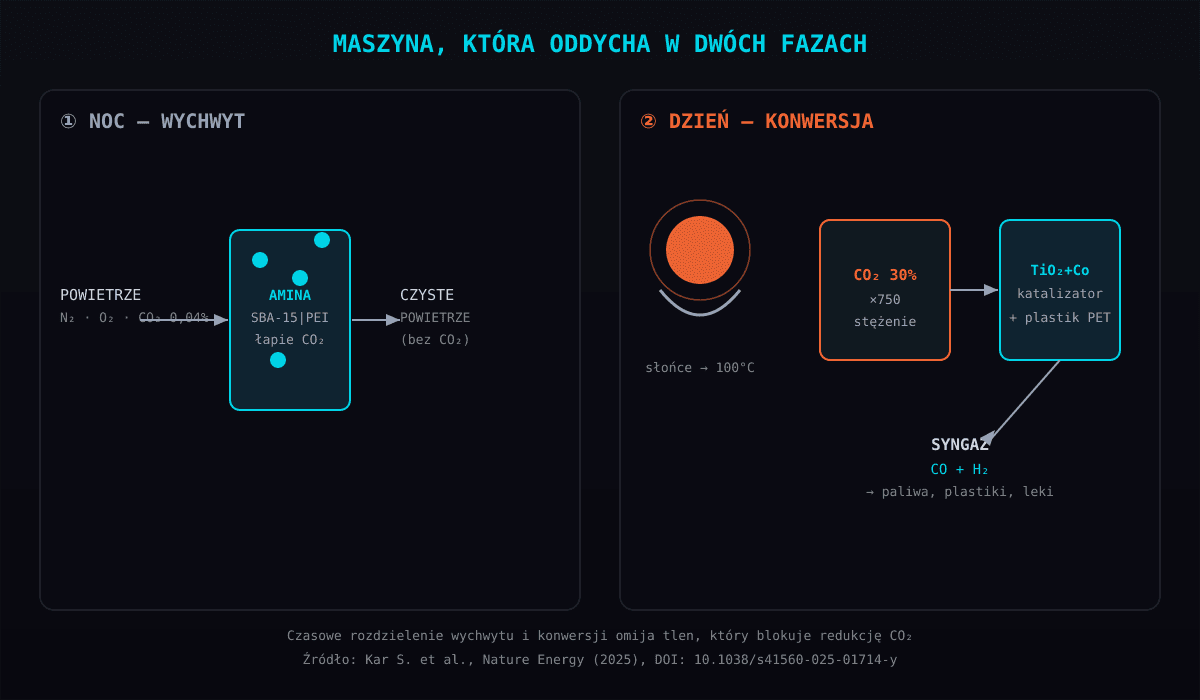
Rys. 1. Maszyna pracuje w dwóch fazach: nocą amina łapie CO₂ z powietrza (0,04%), w dzień słońce uwalnia go w stężeniu 30% i zamienia na syngaz. Źródło: Kar S. et al., Nature Energy (2025), DOI: 10.1038/s41560-025-01714-y.
Why nobody did this sooner
The answer is oxygen.
Air is not just CO₂. A fifth of it is oxygen — and oxygen is a ruthless competitor. When you try to reduce CO₂ in the presence of oxygen, the electrons prefer to react with oxygen. The process meant to make fuel starts producing water and heat. A classic photocatalyst flooded with air simply goes out.
Hence the whole cleverness of the Cambridge idea: separate the time. At night the bed catches CO₂ and lets the other gases pass through — oxygen included. At dawn, when the bed releases concentrated CO₂, there is no oxygen left in the stream. The reduction runs clean. It is like separating the harvest of grain from the milling of flour — you don't do both at once in the same room.
The dream itself is old. Artificial photosynthesis — splitting CO₂ and water with light, the way plants do — has been the Holy Grail of chemistry since the 1970s. Reisner chased it for fifteen years of his career, publishing catalyst after catalyst that worked beautifully in the lab and failed on contact with real air. Because in a test tube you have pure CO₂ from a cylinder. In the atmosphere you have four hundredths of a percent and competing oxygen. The difference between the two is the difference between shooting at a target from a metre and from a kilometre — blindfolded.
That does not mean the machine is factory-ready. The efficiency of converting light into released CO₂ is a fraction of a percent. The molar numbers must be multiplied by thousands. But the architecture — night capture, day conversion, plastic as auxiliary fuel — is the skeleton to build on.
A market waiting for such a machine
The world already pays to pull CO₂ from the air. Direct air capture — DAC — has left the laboratory.
In Iceland operates Mammoth, the plant of the Swiss company Climeworks. It is the largest DAC installation in the world, capturing about thirty-six thousand tonnes of CO₂ a year and injecting it into basalt underground. In Texas rises Stratos, built by 1PointFive using Carbon Engineering technology — half a million tonnes a year at full scale. More are entering the game: Heirloom with limestone that captures CO₂ while turning into rock, and dozens of start-ups with new sorbents.
The cost? Hundreds of dollars per tonne today. The industry's goal is a hundred dollars by the end of the decade — the level at which DAC stops being a curiosity and becomes an industry.
But all these installations do only half the job. They catch CO₂ — and bury it underground or sell it as technical gas. The captured carbon becomes a cost, not revenue. Producing pure CO₂ from air alone costs a hundred and twenty-five to three hundred and thirty-five dollars per tonne. And storing it underground for decades raises questions nobody can answer.
The Cambridge machine reverses this equation. Instead of paying to bury waste, it turns it into feedstock on the spot — without transport, without underground storage. That is the difference between a landfill and recycling, only at the scale of the entire atmosphere.
Of course the devil is in the numbers. Burying CO₂ is cheaper than reprocessing it — which is why almost all of today's DAC installations choose storage. But storage has a cost hidden in time: nobody can guarantee the gas will stay underground for a thousand years. Conversion to syngas is dearer today, but yields a product that sells itself. It is a choice between a one-off cost and a returnable investment. Reisner bets on the latter — and that is why his Cambridge work, though still at laboratory stage, landed in one of the world's most important energy journals rather than a niche catalysis periodical.
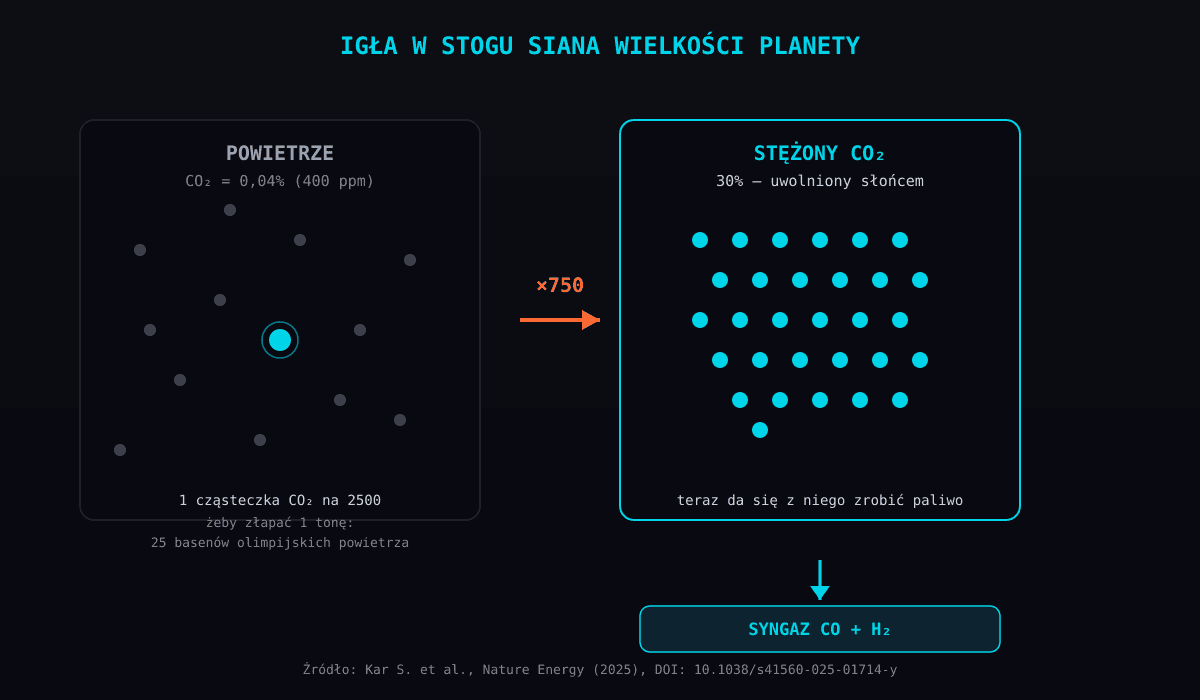
Rys. 2. Igła w stogu siana: w powietrzu CO₂ to jedna cząsteczka na 2500, ale po wychwycie stężenie rośnie 750-krotnie — dopiero wtedy da się z niego zrobić paliwo. Źródło: Kar S. et al., Nature Energy (2025), DOI: 10.1038/s41560-025-01714-y.
Poland: from emissions to feedstock
Poland holds a special place in this story. We are among Europe's biggest CO₂ emitters — hundreds of millions of tonnes a year, with an energy sector still built on coal. For us, carbon dioxide is today a pure cost: rising prices of allowances in the ETS, which within a decade could make coal-fired energy unprofitable.
But the same gas can become a feedstock. Polish chemistry has capture experience. Bartosz Dziejarski of Wrocław University of Science and Technology and Renata Krzyżyńska of AGH belong to a group that has analysed CCUS technologies for years — their review in Fuel from 2023 has over six hundred citations and ranks among the most-cited works on CO₂ capture in the world. A second one, in Materials Today Sustainability, adds another three hundred.
Industry has something to build on. Orlen — Poland's largest company — declares investments in hydrogen and carbon capture. Grupa Azoty, the largest fertiliser producer in the EU, already uses CO₂ to make urea and could draw it from its own emissions instead of buying it. PGE and Synthos look at decarbonisation through the lens of new technology. The money is there: NCN and NCBR fund research, while FENG and the National Recovery Plan fund deployment.
What is missing cannot be bought with a grant. It is the bridge between a chemistry bench and a power plant chimney. A machine that catches CO₂ at night and returns fuel at dawn is exactly that bridge.
For the country that emits the most in the region, the stakes are the highest possible. Within a decade Polish industry will face a simple choice: pay ever dearer allowances for every tonne of CO₂ — or treat the gas as feedstock. The second option requires exactly what the Cambridge team built: a technology that does not run from the problem of low concentration, but turns it into an asset. Time is short. But the recipe is already on the table — written in a single glass tube and a single parabolic mirror.
Sources
- Kar S. et al., Direct air capture of CO₂ for solar fuel production in flow, Nature Energy 10, 448–459 (2025). DOI: 10.1038/s41560-025-01714-y
- Dziejarski B., Krzyżyńska R. et al., Current status of carbon capture, utilization, and storage technologies in the global economy, Fuel (2023). DOI: 10.1016/j.fuel.2023.127776
- Dziejarski B., Krzyżyńska R. et al., CO₂ capture materials: a review of current trends and future challenges, Materials Today Sustainability (2023). DOI: 10.1016/j.mtsust.2023.100483
Comments· 0
No comments yet. Be the first.